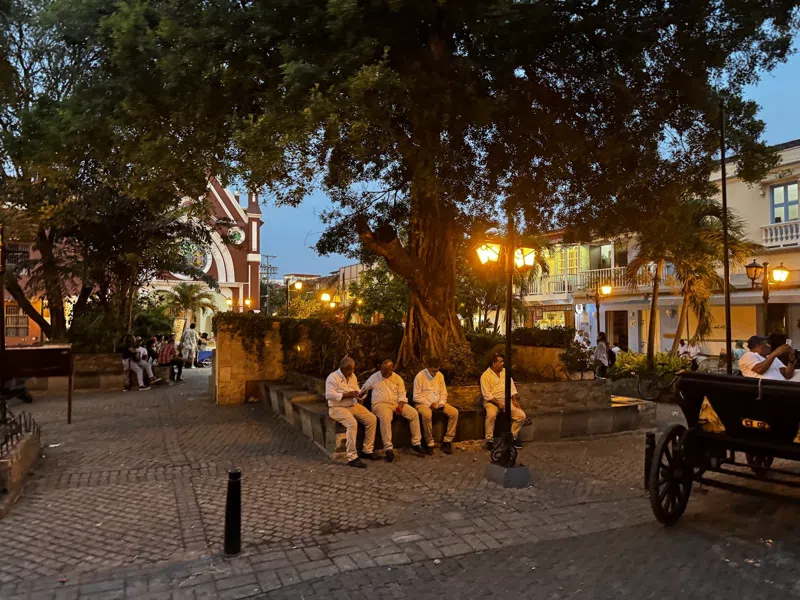
Havana is a low city, and that is the whole reason the view matters here. Most of it is four or five storeys of columns, shutters, water tanks and drying laundry, so the handful of places that rise above the roofline, whether a hotel terrace, a bell tower, a marble mirador or a fortress wall on the far side of the harbour, each hand you a different reading of the same streets. What follows is where to go up, what you see from each, and what it takes to get in.
Vedado's three high points
Start with the one that explains the city. The Memorial José Martí mirador in Plaza de la Revolución is the highest public lookout in Havana, and the small room at the top is where the geography finally makes sense: Vedado's towers stepping down toward the water, the dense grid of Centro Habana behind them, the bay opening east past the fortresses, and the sea wall running off in a long pale curve. Entry is a few dollars for the museum and the lift together. The catch is the lift, which goes out of service often enough that you should ask at the desk before you pay, because the alternative is 567 steps. The lookout holds only a handful of people at a time, so tour groups go up in batches; if you arrive behind a coach, expect a short wait rather than an abandoned afternoon.
A short drive north, Habana Blues Sky Bar sits on top of the Iberostar Selection La Habana, the tower most people know simply as Torre K, in the middle of Vedado. It opened in February 2025 as the tallest building in Cuba, which makes this the single highest bar in the city, a plain fact whatever you think of the tower itself. Plenty of habaneros think a great deal about how it now dominates the Vedado skyline. That argument belongs to the street below; from up here you get the cleanest 360 in Havana, with the Malecón on one side and the inland sprawl on the other. Daytime access is walk-in and family-friendly, so it works as a mid-afternoon stop with children in tow. Evening cocktail service runs 6pm to 1am and is worth booking ahead if there are more than a few of you; drinks land at roughly 8 to 15 USD.
The view locals actually send you to is La Torre, on top of the Edificio FOCSA in Vedado, the 1950s concrete giant that held the title of tallest thing in Havana for half a century. It remains the best sit-down panorama in the city. There are two ways in, and the distinction matters. The restaurant is reservation-only with a dress code and mains around 20 to 35 USD, a proper occasion and the right choice for an anniversary or a long lunch with the glass wall beside you. The adjoining bar has exactly the same view, no dress code and no booking, and you can hold it for the price of a drink. Couples on a budget should walk straight past the host stand and into the bar without embarrassment; the sunset is identical from both rooms.
Old Havana at roof level
The old town rewards a lower, closer look, and the strangest way to get it is the Cámara Oscura on the roof of the Edificio Gómez Vila on Plaza Vieja. It is the only camera obscura in Latin America and the Caribbean: a darkened room where a lens and mirror throw a live, moving image of Havana onto a white dish while an operator narrates what you are watching, in Spanish, English, French or Italian. Sessions take about ten people, so larger groups are split and rotated through. The ticket is nominal, effectively under a dollar, and the outdoor terrace and cafeteria alongside stand perfectly well on their own as a viewpoint if the dark room is full. It runs daily, roughly 8.30am to 5.30pm, so this is a daylight errand and cannot be folded into a sunset plan.
Five minutes downhill toward the water, the bell tower of the Basílica Menor de San Francisco de Asís in Old Havana was once the tallest structure in the city and still gives the best low-level view of the harbour and the old quarter's roofline: tiles, terraces, cisterns, the cranes on the far quay, all close enough to read. The stairwell and the platform at the top are tight, so groups go up in ones and twos rather than as a party. A small museum entry of a few dollars covers the sacred-art collection and the nave as well; the basilica itself functions mainly as a concert hall now, and the acoustics are the reason to linger on the way back down.
For something more intimate, the Roof Garden at Hotel Ambos Mundos in Old Havana puts you level with the cathedral towers rather than above everything, and that changes the picture entirely. You are inside the roofscape rather than looking down on it, close enough to see washing lines and the state of the plaster. This was Hemingway's Havana hotel, which accounts for the crowd, but the terrace is modest in size, fine for two, fine for six, awkward for twenty. It is open to non-guests, booking is not normally needed, and cocktails run about 5 to 8 USD.
Parque Central and the Capitolio dome
Three rooftops share the Capitolio, and they sit at three completely different price points.
The best value viewpoint in Havana is the Hotel Inglaterra rooftop terrace on Parque Central. There is no entry fee, no dress code, and it is rarely full enough to turn anyone away. You simply walk in and take the lift. Cocktails are around 3 to 5 USD, the Capitolio dome sits right there in front of you, and there is live music most nights. By day it is a sun terrace; after dark it becomes a bar and grill. If you are travelling with a large group and do not want to negotiate a door policy, this is the easy answer.
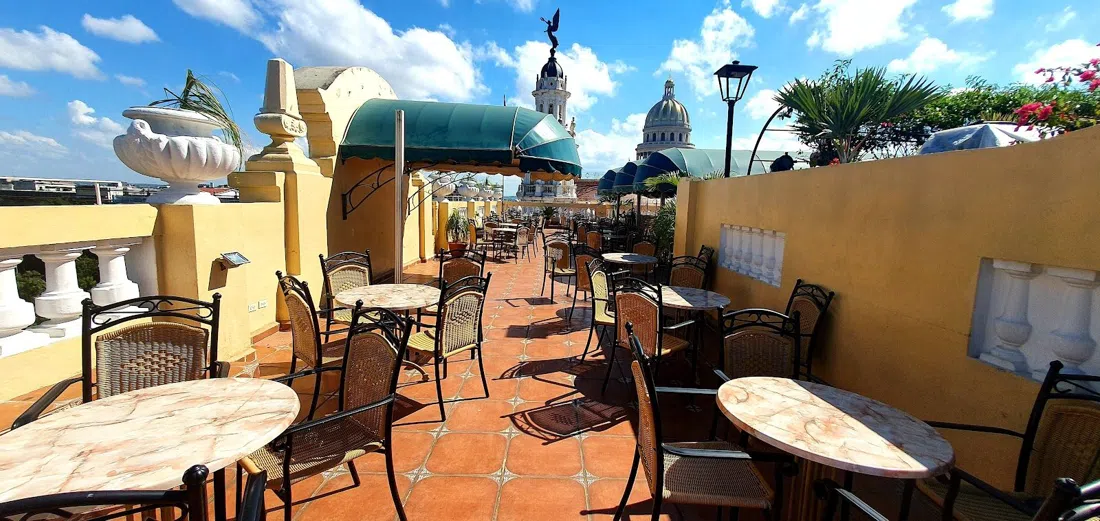
Next door, Mirabana on top of the Iberostar Selection Parque Central has the widest rooftop footprint in the old town, with an air-conditioned lounge alongside the open terrace, which makes it the reliable choice in August heat or a sudden downpour. Dress is casual, groups are handled well, live music plays most evenings, and cocktails sit around 7 to 12 USD. Arrive about an hour before sunset if you want a place at the rail rather than a table set back from it.
The closest eye-level view of the Capitolio dome anywhere in the city belongs to El Surtidor, the pool terrace and bar at the Gran Hotel Manzana Kempinski La Habana, with the San Cristóbal panoramic restaurant sharing the same outlook. It is also Havana's top price band, with cocktails at 12 to 18 USD, and the access rules are real: the roof is for hotel guests, and outside visitors are admitted by prior reservation only. Groups must book and be confirmed in advance. Do not turn up unannounced with eight people and expect charm to work. The door policy is enforced, and being sent back down to the lobby in front of your friends is a bad start to an evening. Booked properly, it is the most polished rooftop in the city. If you would rather solve the problem by sleeping at the height you want to drink at, the Havana hotel search covers the Parque Central and Old Havana towers.
Centro Habana, one staircase at a time
La Guarida — Bar Mirador in Centro Habana is the climb everyone describes afterwards: a grand, half-ruined tenement staircase, washing strung across the landings, neighbours going about their day, and then a rooftop bar at the top of it. The bar keeps its own tapas and cocktail menu, so you can go up purely for the view and a drink without committing to the full restaurant downstairs, though if you want dinner too you should reserve well in advance. Cocktails run roughly 8 to 12 USD. The terrace is compact. A couple or a group of four will do well; a group of twelve will not.

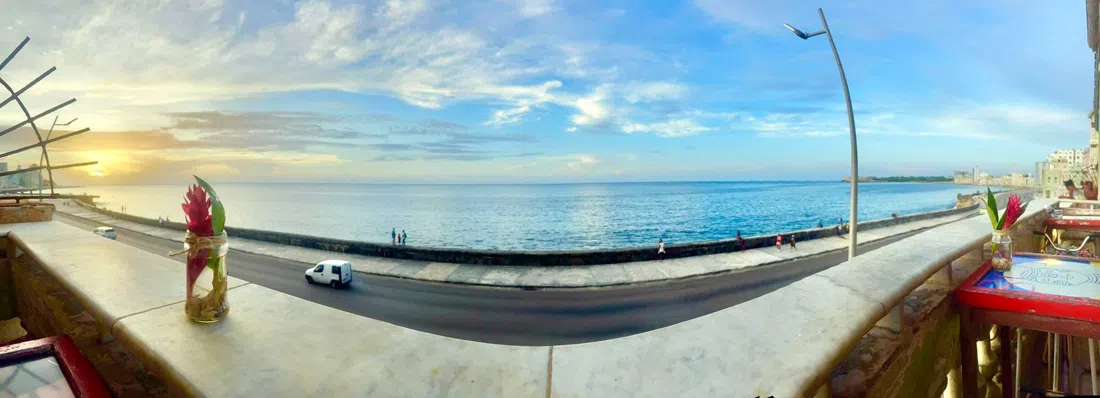
Malecón 663 in Centro Habana is the outlier on this list, because the view is the ocean rather than the city. The boutique hotel's roof faces the sea wall, and on a rough day the spray comes over the stones below you while a band plays behind. It is intimate rather than large, so call ahead for more than a handful of people; cocktails are around 8 to 12 USD, and there is a bistro and concept store downstairs if you arrive early. For a first night in Havana, when you want the water and the noise rather than a panorama, this is the one.
The chimney terrace in Vedado
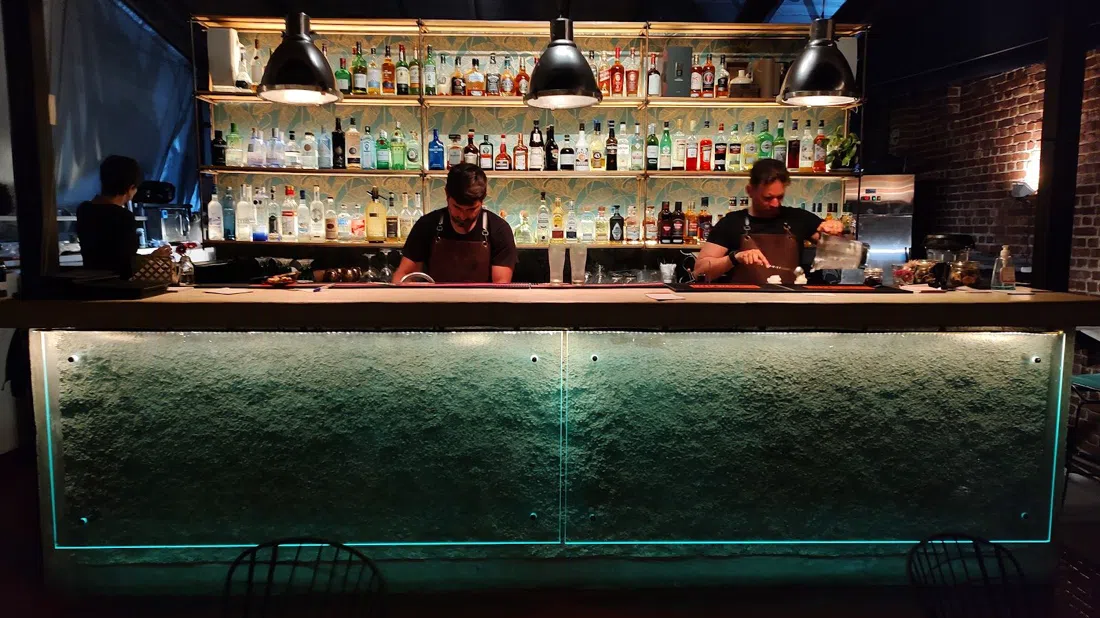
El Cocinero in Vedado occupies a former cooking-oil factory, and its terrace wraps around the old brick chimney, a lower and more urban view than any of the towers, architecturally unlike anywhere else in the city. It also sits directly beside Fábrica de Arte Cubano, which opens at 8pm Thursday to Sunday, so it has become the standard place to eat and drink while waiting for the art factory to open its doors. The bar is walk-in and the terrace is large, which makes it genuinely group-friendly; book if you want dinner. Cocktails run about 5 to 9 USD.
Across the harbour, looking back
No rooftop in Havana can show you Havana itself as a skyline. For that you cross the water.
The cheapest big view, and the most enjoyable to reach, is the Cristo de La Habana in Casablanca. A commuter ferry leaves the Old Havana terminal on San Pedro roughly every fifteen minutes and takes about the same to cross; the fare is nominal, and the passengers are people going home with shopping rather than tourists. From the dock it is a short, steep walk up to the statue, where the terrace is open, free and unticketed. You look straight back across the harbour mouth at the old town, and the ferry itself is half the pleasure.
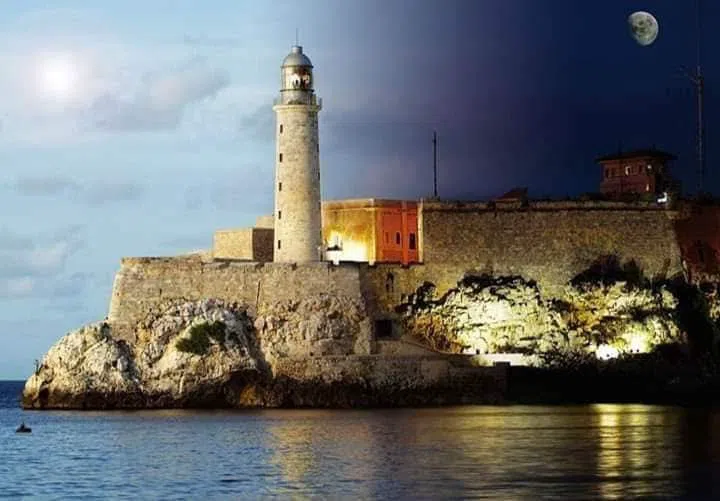
Castillo de los Tres Reyes del Morro, on the headland above the same channel, gives the classic postcard angle: the city seen from outside, low and pale along the water, with the Malecón running away to the west. Entry is around 3 USD with a small extra charge for the lighthouse, though lighthouse access is intermittent, so treat the climb as a bonus rather than the reason for coming. The ramparts are wide and open, which makes it comfortable for groups.
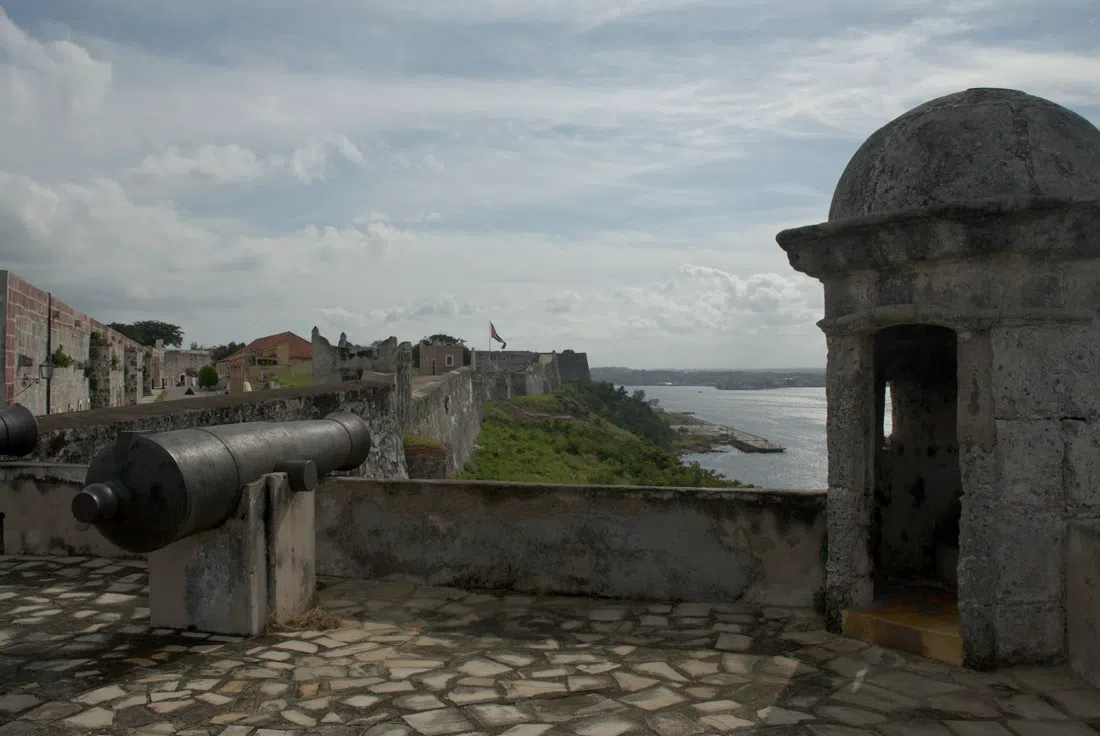
Alongside it, Fortaleza de San Carlos de la Cabaña is the largest colonial fortress in the Americas, with bars, restaurants and a great deal of wall to spread out along. Its real draw is the 9pm cañonazo, when soldiers in 18th-century uniform march out and fire a cannon over the harbour, a ritual that survives from the days when the shot announced the closing of the city gates. It also delivers the city view at exactly the right hour, with the lights coming on across the water. The march begins around 8.40pm, so be on the wall by 8.30 to claim your spot. Tickets are a few dollars, higher on cañonazo nights, and the Che Guevara command museum is on the same site.
Getting up there, paying, and timing it
The viewpoints split into three clusters: Old Havana and Parque Central, which you walk; Vedado, which is a short taxi ride; and the far side of the harbour, reached either by the San Pedro ferry for Casablanca and the Cristo, or by road through the tunnel for the two fortresses. Taxis are negotiated before you get in, not metered, so agree the number at the kerb.
Bring cash and plan the whole day around it. Prices here are quoted the way these venues quote them, mostly in USD equivalent, and the small sites, meaning the Cámara Oscura, the bell tower, the Martí mirador and the ferry, cost very little. A realistic day of views runs from under 10 USD if you stick to the monuments, ferry and the Inglaterra terrace, to 60 or 70 USD a head if you book the Kempinski roof or dinner at La Torre.
For timing, the daylight attractions close early: the camera obscura shuts around 5.30pm and the bell tower around 6pm, so do those before mid-afternoon and save the rooftops for the hour before sunset. Havana's sunset is fast, and the rail seats at Mirabana and Habana Blues fill about an hour before it. If you want a single, well-sequenced evening, take the ferry to the Cristo in late afternoon, come back, drink at the Inglaterra or Ambos Mundos as the light goes, then cross to La Cabaña for the cannon. For where these sit in the rest of the city, see the Havana guide.